
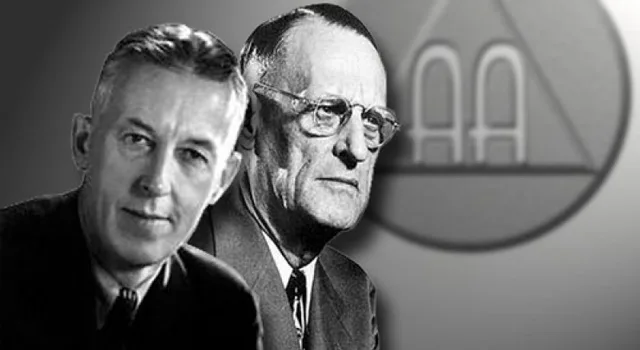
Alcoholics Anonymous began in 1935 with two men talking about drinking.
It did not begin with a General Service Office, a Conference, a service manual, a collection of pamphlets, or a committee to decide which committee should study the question.
Those came later.
So did the Twelve Traditions. And the Twelve Concepts. And the arguments about money, publicity, leadership, literature, and who was supposed to make the coffee.
The remarkable thing about AA isn’t that its founders had everything figured out. They didn’t.
It’s that the Fellowship gradually discovered how to survive its own success.
A Rather Unlikely Beginning
In 1935, Bill W. and Dr. Bob met in Akron, Ohio. Both had struggled desperately with alcoholism. Both had encountered the Oxford Group, a spiritual movement that influenced AA’s early development.
Their meeting helped launch a fellowship that would eventually spread around the world.
But nearly everything we now associate with AA had to be worked out through experience.
The Big Book appeared in 1939. The Twelve Traditions emerged from years of group difficulties and experimentation. AA’s service structure developed as the Fellowship grew and its founders considered how it could continue without them.
None of this happened without disagreement.
The Stories Behind the Principles
In this series, we’ll explore eight chapters in AA history:
- The Washingtonians, who discovered the power of alcoholics helping alcoholics nearly a century before AA.
- The Oxford Group and its influence on AA’s earliest members.
- The meeting between Bill W. and Dr. Bob.
- The financial and publishing adventures surrounding the Big Book.
- The newspaper and magazine coverage that brought AA into American living rooms.
- The early controversies that helped produce the Twelve Traditions.
- The women who helped shape the Fellowship.
- The extraordinary decision to place AA’s future in the hands of its members.
Some of these stories are inspiring. Some are surprising. A few are downright peculiar.
And together they remind us that AA was built by human beings—alcoholics, no less—who were learning as they went.
Why Bother With History?
Because many things we take for granted today were once radical experiments.
A fellowship without membership dues? Leaders who don’t govern? Groups that are largely autonomous? An organization that deliberately avoids taking positions on most of the world’s problems?
These ideas didn’t arrive fully formed.
They emerged from experience, mistakes, disagreements, and occasionally the discovery that a perfectly wonderful idea could produce perfectly dreadful consequences.
Understanding that history can help us appreciate why AA works the way it does—and why some of its peculiarities are worth preserving.
We’ll draw on AA’s own historical publications and archives, with links for readers who want to explore further.
Further reading: AA’s History and The Start and Growth of AA.
If you’re new, try a few different meetings. Your room is out there.