
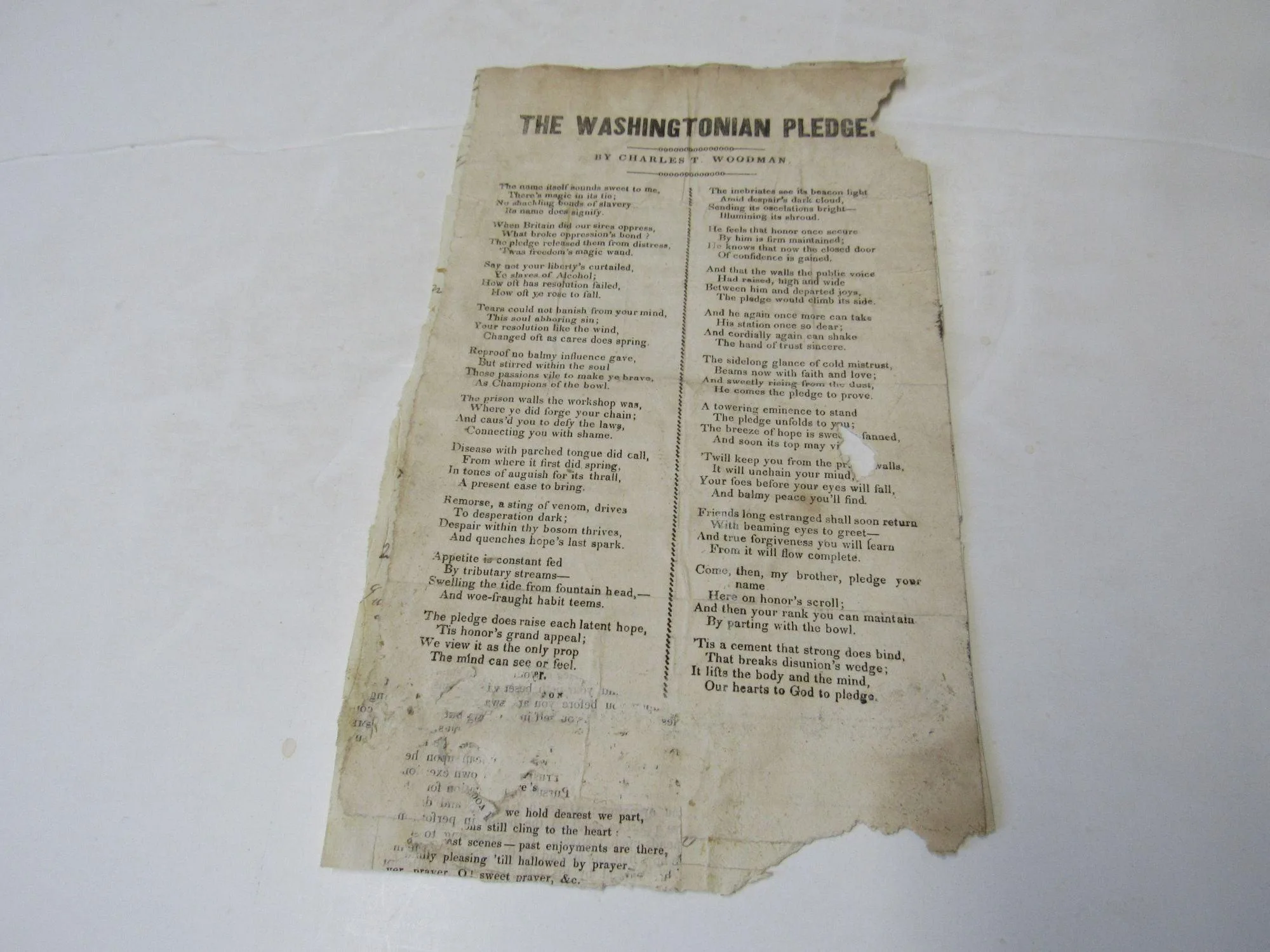
In 1840, six drinking buddies in Baltimore came up with an idea.
What if they stopped drinking?
And what if they helped other drinkers stop, too?
This was nearly a century before Bill W. met Dr. Bob. There was no Big Book, no Twelve Steps, and certainly no General Service Conference.
But there was a tavern, a group of men who knew something about drinking, and an idea that would sound remarkably familiar to anyone who has attended an AA meeting.
They called themselves the Washington Temperance Society.
History remembers them as the Washingtonians.
Six Men Walk Out of a Tavern
According to an account published in AA’s Box 4-5-9 newsletter, the Washingtonians began in Baltimore in April 1840.
Their founders were workingmen, including blacksmiths, a carpenter, a silversmith, and a coachmaker.
They pledged to abstain from alcohol and encouraged others to join them.
Their early meetings were held at Chase’s Tavern, which may have been an awkward location for a temperance society.
Eventually, the tavern owner’s wife reportedly objected to the loss of business.
You can understand her point.
The meetings moved elsewhere, and the organization grew astonishingly quickly.
Within a year, approximately 1,000 former drinkers and thousands of supporters were celebrating the society’s anniversary.
Soon, Washingtonian societies appeared in cities across the country.
The Power of One Drunk Helping Another
The Washingtonians had discovered something important.
Instead of respectable citizens lecturing alcoholics about their disgraceful behavior, former drinkers told their own stories.
They understood the problem because they had lived it.
Their approach even caught the attention of Abraham Lincoln.
In an 1842 address to a Washingtonian society in Springfield, Illinois, Lincoln praised the effectiveness of people who had experienced alcoholism speaking to others who were struggling.
He recognized something that AA members would later recognize themselves: identification can accomplish what condemnation rarely does.
The Washingtonians also inspired women’s auxiliary organizations, including the Martha Washington societies, which supported families and helped women struggling with alcohol.
For a time, the movement was enormous.
Historical estimates of its reach vary widely, and the number of people who signed temperance pledges should not be confused with the number who achieved lasting sobriety.
Nevertheless, the Washingtonians were a national phenomenon.
So What Happened?
Here is where the story gets interesting.
The Washingtonians gradually became entangled with the broader temperance movement.
Their original focus on helping individual alcoholics was increasingly overshadowed by public campaigns, competing organizations, and controversies over alcohol policy.
Prominent personalities became important to the movement, too.
As enthusiasm faded and members joined other temperance organizations, the Washingtonians lost much of their original identity.
Their rapid decline became a cautionary story for AA.
Bill W. later pointed to the Washingtonians when discussing the importance of AA’s Traditions, particularly singleness of purpose, anonymity, and avoiding outside controversies.
Of course, the Washingtonians did not have AA’s Twelve Steps, Traditions, or organizational experience. Their circumstances were different, and historians cannot reduce their decline to a single cause.
But the comparison remains instructive.
The Lesson AA Took From Them
The Washingtonians showed that one alcoholic helping another was an extraordinarily powerful idea.
They also demonstrated how easily a movement can drift away from the purpose that brought its members together.
AA eventually developed its Fifth Tradition around a simple principle: each group has one primary purpose—carrying its message to the alcoholic who still suffers.
And Tradition Ten keeps AA from taking positions on outside issues.
Those principles didn’t arise in a vacuum. They reflect lessons drawn from AA’s own experience and from earlier movements.
The Washingtonians deserve to be remembered, not simply because their movement declined, but because they helped demonstrate something profoundly hopeful.
Alcoholics could help other alcoholics recover.
That was a pretty remarkable discovery in 1840.
It still is.
Further reading: Box 4-5-9: “Fate of Washingtonians Reminds A.A. To Be Mindful of Traditions” and Markings: “The Washingtonians”.
Sidenote: Abraham Lincoln’s 1842 Washingtonian Temperance Society address
If you’re new, try a few different meetings. Your room is out there.